Current Activities

جائزة العقبة للتميز في العمل الاجتماعي

14 December 2008

ضمن برنامج تطویر كفاءة مؤسسات المجتمع المدني في منطقة العقبة الذي تنفذه سلطة منطقة العقبة الاقتصادیة الخاصة بدعم من الوكالة الأمریكیة للتنمیة الدولیة

  • تلعب مؤسسات المجتمع المدني غیر الربحیة دورا متزایدا في دعم المجتمع المحلي وتعزیز وصوله للخدمات المختلفة كالتعلیم والتأهیل والصحة والتدریب والتوعیة، وكنتیجة لتزاید دور القطاع الخاص وسیاسات التحریر الاقتصادي وانحسار دور القطاع العام، أصبح من الضروري تطویر أسالیب وأدوات هذه المؤسسات في نواحي عدة اهمها الالتزام بالشفافیة والمسؤولیة في الإدارة والوضوح والمشاركة في توظیف الأموال وتحدید الأنشطة والبرامج بما یحقق اكبر قدر من الفائدة للفئات المستهدفة والمجتمع الذي تخدمه .
  • ومن هذا المنطلق تسعى سلطة منطقة العقبة الاقتصادیة الخاصة ممثلة بمدیریة تنمیة المجتمع المحلي إلى تطویر مؤسسات المجتمع المدني من خلال برامج تدریبیة لتطویر الكفاءة المؤسسیة لتمكینها وتأهلها من الوصول للدعم لبرامجها المختلفة، ویأتي إطلاق جائزة العقبة للتمیز في العمل الاجتماعي كجزء من هذا الدعم و تكریما لتلك المؤسسات الرائدة في العمل المجتمعي التنموي وتشجیعا لها للاستمرار في ذلك من خلال خلق جو من التنافسیة بین المؤسسات في تقدیم الخدمات للمجتمع بشكل عام ولفئاتها المستهدفة بشكل خاص .

تهدف جائزة العقبة التنمویة إلى دعم وتطویر العمل المجتمعي التنموي غیر الربحي في منطقة العقبة من خلال دعم وتحفیز الاستقرار المؤسسي لمؤسسات المجتمع المدني وتعزیز وتقویة الشراكة مع المجتمعات المحلیة التي تخدمها هذه المؤسسات . فتسعى الجائزة إلى تحقیق الغایات التالیة :

  • إظهار نماذج ناجحة لمؤسسات المجتمع المدني المجتمعیة غیر الربحیة في العقبة .
  • تشجیع الثقة في عمل المؤسسات غیر الربحیة المجتمعیة في العقبة . بناء مؤسسات مجتمعیة تشجع وتدعم ممارسات المسؤولیة والتشاركیة في العمل التنموي .
  • دعم المشاركة الفعالة بجهود التنمیة المحلیة المستدامة .


جائزة العقبة للتمیز في العمل الاجتماعي موجّهة لكافة مؤسسات المجتمع المدني غیر الربحیة العاملة والمسجلة في منطقة العقبة(الجمعیات الخیریة، الجمعیات والأندیة الثقافیة، الأندیة الشبابیة،الجمعیات البیئیة) .


اضغط هنا لتنزيل المعلومات الأساسية. اضغط هنا لتنزيل طلب المشاركة.

Aqaba Micro-business Incubator Graduates Their First 22 Prospective Entrepreneurs

18 November 2008

اAqaba Micro-business Incubator Graduates Their First 22 Prospective Entrepreneurs


On Tuesday, November 18, 2008, the Aqaba Micro-business Incubator, located in the Noor Al-Hussein Foundation building in Aqaba, graduated their first 22 prospective entrepreneurs who had successfully completed the first "How to Start Your Business" training program series.  The training program was implemented in cooperation with ASEZA and supported by a grant from the USAID-funded Aqaba Community and Economic Development (ACED) Program.

Ms. Karima Dabet, Director of the ASEZA Local Community Directorate, and Mr. Larry Hearn, ACED Program Chief of Party, distributed certificates to program graduates. The graduation was attended by members of the Aqaba community and ASEZA and ACED Program staff.

"How to Start Your Business" is a comprehensive training program for the Aqaba community in which prospective entrepreneurs participate in eight training days spread over two to three weeks covering the following topics:
 
-     Assess and strengthen your potential as an entrepreneur
-     Assess and strengthen your personal financial situation
-     Identify a good business idea
-     Evaluate viability of your business idea
-     Decide your start up strategy
-     Identify a legal entity for your new business
-     Choose the location for your new business
-     Determine your required start-up capital
-     Prepare your business plan
-     Prepare your feasibility study

One graduate of the "How to Start Your Business" course expressed her appreciation for the course stating, "Over the last five months I knew my idea was viable, but after completing the course I now realize that without this training I would have for sure not been successful in my project."

The ACED Program also conducted an awareness session on "Entrepreneurship" for Aqaba reporters on the 18th, to give them a brief idea about the project and the intended impact of this project for the community.

After the participants have completed their training, incubator staff will assist the graduates with their feasibility studies which could subsequently be submitted to the Aqaba Micro-Business Incubator with a request to be incubated. The incubator will supply premises for five to ten prospective entrepreneurs for a period of six to nine months.  Logistical and technical support will also be provided to the incubated entrepreneurs.

Neighborhood Development Activity– (Sharqia & Gharbia) Al-Radwan Neighborhood

1 November 2008

Background:


The Sharqia Neighborhood mobilization benefited from the unique past experience with its active NET and collaboration with the local government. Starting from February 2008, the partners (the ACED Program, LCDD and JRF) raised awareness for the program in Sharqia, conducted a needs assessment survey of 120 Sharqia families, and held the first Neighborhood Wide Meeting – hosted by ASEZA/LCDD. At the Neighborhood Wide Meeting, the survey results were presented to over 130 participants (including 40 women). Then the participants selected 11 community members (5 men, 5 women, and 1 youth) to represent them on a NET, and voted to identify the top three priorities for the neighborhood from a “pool” of needs revealed from the survey.


The NET members have held regular weekly meetings facilitated by the NDA partners in order to analyze the situation and needs of the neighborhood; they conducted a priority project verification survey in the Neighborhood to determine which of the top three projects citizens felt was most urgent. Of the 586 citizens participating in the survey, 242 (41%) voted for the highest scoring project: Creating Safe Access for Students to Public Schools. Since determining the first priority project, the NET has continued their weekly meetings and worked with ASEZA engineers, their community and private sector companies in order to move toward successful mobilization of community resources to support project implementation.


The ACED Program and LCDD agreed with JRF and the Sharqia NET to expand the second mobilization of Sharqia to include the Gharbia neighborhood. These adjacent areas as combined are known as Al-Radwan.

Al-Radwan Neighborhood Mobilization Activities starting from October 25 to date:


  • NDA partners and NET worked together to evaluate the NET’s work and the first Neighborhood’s mobilization. Then the NET selected 25% percent or 3 members of the Sharqia NET to continue with a newly selected Al-Radwan NET.
  • Held initial informative visits with key stakeholders, including school directors, NGOs, religious leaders, other known community leaders.
  • Recruited and provided basic awareness of the program to 5 Neighborhood volunteers to support the planned initiative.
  • Raised awareness of the program and the Neighborhood Wide Meeting throughout the Al-Radwan Neighborhood by having volunteers as well as ACED Program, LCDD and JRF staff hang posters, distribute brochures, and talk to individuals and community leaders in their residences, workplaces, and meeting places.
  • Through a simple door-to-door survey, collected initial information from 210 families in Al-Radwan on priority needs and to get their informal nomination of potential leaders for the NET.
  • Conducted 3 focus groups (2 for women and 1 for men) with 30 participants to verify the survey results, collect additional needs, and explore additional potential leaders to be nominated for the NET.
  • Contact nominated Neighborhood leaders about participating in the Neighborhood Enhancement Team (NET) and the Neighborhood Wide Meeting (NWM).
  • Held the NWM to discuss the priority needs of the community and to introduce the new members of the Al-Radwan NET. Over 65 meeting participants signed the attendance sheets.


Details and Outcomes of the Al-Radwan Neighborhood Wide Meeting:

  • LCDD and ACED Program representatives introduced this Neighborhood Development Activity as an innovative partnership between ASEZA and the citizens of Aqaba, which was actually piloted with Sharqia and expanded in the second mobilization of Sharqia to include the Gharbia Neighborhood.
  • Sharqia NET representatives presented their experience with the Sharqia, the vision they created for the Neighborhood, and the work they accomplished.
  • The NWM facilitator explained the step-by-step process for the Neighborhood, including:

      o What had been completed already (survey, focus groups, awareness building);

      o What would be accomplished at this NWM (discussion of local priorities, formal selection of the Al-Radwan NET members, etc.).

      o What the next steps were (NET translates needs to potential projects and verifies these with community, applies to ASEZA and ACED Program for evaluation for potential funding support or other technical assistance, identifies/raises community contribution, oversees implementation of project, repeats the process starting with identifying priorities).

  • The NWM facilitator presented the results of the survey and asked smaller groups to discuss these priorities with co-facilitators in order to choose their three highest priorities.
  • At the meeting, attendees ranked their three highest priorities as:

      o Poor conditions/services for neighborhood cleaning and waste management,

      o Lack of security presence in the Neighborhood, and

      o Streets, sidewalks and street lighting maintenance.

  • The NWM facilitator explained the roles and responsibilities of the volunteers selected by the citizens for the NET.
  • The NWM facilitator explained that 12 volunteers (3 from the previous Sharqia NET, plus 9 nominated in focus groups and Survey) had accepted to be on the Al-Radwan NET and that more volunteers could be added at this NWM. 1 man was added.
  • The Al-Radwan NET was formed with 13 members (4 women, 6 men, 2 female youth, and 1 male youth) and presented to the Al-Radwan citizens at the NWM.
  • The new Al-Radwan NET members signed the commitment sheet in the presence of their fellow citizens.

ACED Program Graduates 50 students in Hospitality and Tourism English Training

23 October 2008

On October 21, 2008 the USAID/ Aqaba Community and Economic Development (ACED) Program, celebrated the graduation of a group of 50 trainees who completed and a Hospitality and Tourism English Training Course.  The ACED Program coordinated with the Tourism Directorate in the Aqaba Special Economic Zone Authority (ASEZA) in awarding a contract to World Associates who conducted the training.


The event was attended by USAID Cognizant Technical Officer for the ACED Program Cybill Sigler, Ms. Mona Hawa, Director of the ASEZA Tourism Directorate and Mr. Larry Hearn, ACED Program Chief of party, in addition to various other ACED Program staff.


During her speech, Ms. Hawa encouraged the students to peruse a career in tourism as there are increasing opportunities in this filed and drew their attention to the “INJAZ Tourism Career Fair” that will start October 29th with the funding support of the USAID/ACED Program.


Throughout the event the students show high level of enthusiasm, even one of them commented, ”I didn’t understand all what they said in English, but next time I will.” Moreover,Ali Ben Khalaf and Mahmoud Ezzideen two students who participated in the training, both spoke about the importance of the English language in their career, and thanked the World Associates, USAID and the ACED Program who made the training possible. 

The training program lasted five weeks in which the English courses were divided into three levels. The trainees were composed of students from the Vocational Training Center and the Aqaba University College, potential employees, as well as some current employees in the Hospitality Sector.  


This training was one of a series of courses that will be oriented towards enhancing the skills of employees and job-seekers within the Hospitality and Tourism Sector.

Neighborhood Development Activity Mobilization the third Neighborhood – Old Town

9 October 2008
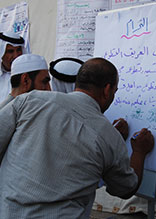
 Old Town NET members signing the commitment statement in front of Citizens

The citizens of Old Town have benefited from their unique past experience with an active citizen group and collaboration with the local government. With the support of Aqaba Development Corporation (ADC) and the Jordan River Foundation, a group of Old Town Neighborhood members had already formed a local citizen’s “committee” to analyze the most pressing needs for their neighborhood and recommend potential projects for ADC to fund. During this period (from late 2006 through mid-2008), a detailed citizen survey and needs assessment was completed and several priority issues identified. In June 2008, ADC, ASEZA and the ACED Program signed an MOU to incorporate Old Town into the ongoing Neighborhood Development Activity (NDA) of the ACED Program. Since the MOU signing in June, the steps taken toward mobilization of Old Town Neighborhood include:  
  • Held initial informative visits with key stakeholders including: school directors, NGOs, religious leaders, other known community leaders. [8/13-14 /2008]
  • Met with the members of the existing “committee” in the Old Town to introduce the NDA. Explained Neighborhood Enhancement Team (NET) roles and responsibilities, and encouraged participation in the NET and the Neighborhood Wide Meeting. [8/16 /2008]
  • Summarized the previously completed Old Town needs assessment survey conducted by ADC through JRF. [8/14 /2008]
  • Conducted 4 focus groups (two for women and two for men, both including youth attendees) with 52 participants to verify the survey results, collect additional needs, and nominate additional leaders for NET; [8/17-18 /2008]
  • Contacted nominated neighborhood leaders about participating in the NET and the Neighborhood Wide Meeting. [8/22-26 /2008]
  • Raised awareness of the program and the Neighborhood Wide Meeting throughout the neighborhood by having volunteers as well as ACED Program, LCDD, ADC and JRF staff hang up posters and distribute brochures. [8/24-30/2008]
  • Held the Neighborhood Wide Meeting to discuss the priority needs of the community and to formally select members for the Old Town NET. Over 90 participants attended the meeting (87 participants signed the attendance sheets). [8/30/2008]
 Details and Outcomes of the Old Town Neighborhood Wide Meeting: 
  • LCDD, ADC and ACED Program representatives introduced this Neighborhood Development Activity as a new and innovative partnership between ASEZA and the citizens of Aqaba starting with Sharqia and Al-Rimal neighborhoods, and announced that Old Town is the third neighborhood invited to partner with the NDA.
  • Facilitator explained the step-by-step process for the Neighborhood, including:
    • What had been completed already (survey, focus groups, awareness building);
    • What would be accomplished at this meeting (discussion of local priorities, introduce Old Town NET members.
    • What the next steps are (NET translates needs to potential projects and verifies these with community, applies to ASEZA, ADC and the ACED Program for funding support, raises community contribution, oversees implementation of project, repeats the process starting with identifying priorities).
  • Facilitator presented the results of the survey and asked smaller groups to discuss these priorities with co-facilitators in order to choose their three highest priorities.
  • At the meeting, attendees ranked their three highest priorities as:    
    • Poor environmental and health situation including poor waste collection, lack of pest control, poor waste network, poor water systems and debris in some areas like unoccupied houses;
    • Lack of social awareness programs and counseling including family counseling, education, awareness programs for youth on the dangers of smoking, alcohol and drug abuse; and
    • Lack of sufficient attention to public properties including the health center, the cemetery and mosques.
  • Facilitator explained the roles and responsibilities of the volunteers selected by the citizens for the NET.
  • Facilitator explained that 11 volunteers (from the existing “committee” plus those nominated in focus groups) accepted to be on the Old Town NET and that more volunteers could be added at the meeting. Four men and two women were added.
  • Formed Old Town NET with 17 members (6 women, 9 men, 1 female youth, 1 male youth).